The landscape of post-secondary education across Canada has shifted dramatically over the past decade. Once viewed strictly as a transitional period of rigorous intellectual enrichment, attending a Canadian university or college has increasingly become synonymous with navigating an intricate, high-stakes ecosystem of systemic pressure. From the lecture halls of the University of Toronto to the digital learning interfaces at the University of British Columbia, Canadian undergraduate and postgraduate students are exhibiting unprecedented rates of psychological distress. Academic burnout is no longer an isolated experiential hazard felt only during final exams; it has evolved into a chronic, institutionally driven psychological phenomenon characterized by emotional exhaustion, depersonalization, and a profound reduction in personal accomplishment.
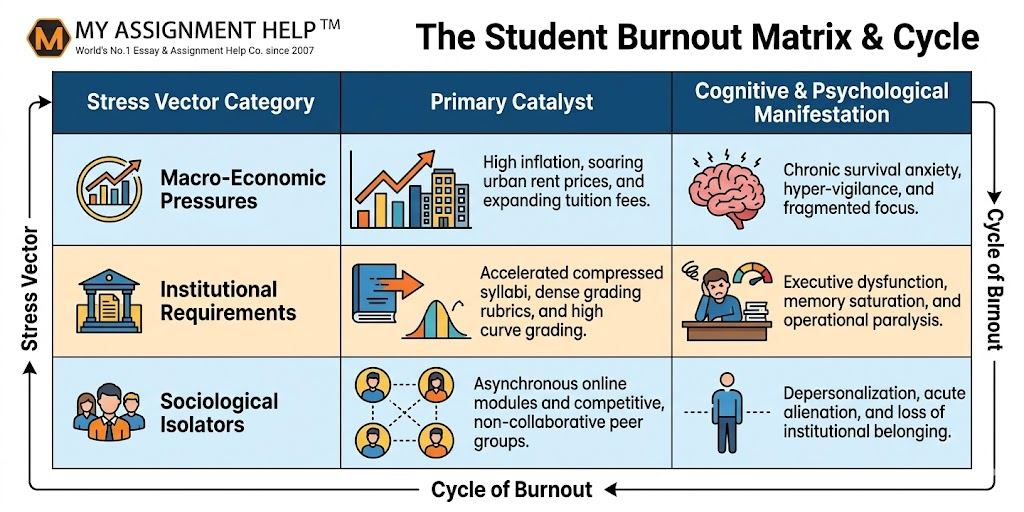
To fully deconstruct this crisis, one must look beyond individual time-management deficiencies and evaluate the systemic stress vectors that define contemporary Canadian higher education. The psychological framework of burnout operates on a spectrum where prolonged cognitive overload intersects with dwindling external resources. When a student’s internal adaptation mechanisms are systematically outpaced by external institutional demands, executive cognitive functions begin to degrade. This reality manifests as memory fragmentation, impaired analytical capacity, and acute emotional fatigue, fundamentally shifting how students interact with their curriculum and academic obligations.
As academic workloads increase in structural complexity, students frequently find themselves unable to synthesize vast amounts of theoretical frameworks within contracted semester timelines. For instance, navigating advanced methodological structures often requires specialized intervention; when facing overwhelming multi-disciplinary requirements, obtaining strategic assistance through a professional Psychology Assignment Help service in Canada serves as an essential academic buffer, allowing undergrads to decompress their schedules, map out cognitive demands effectively, and preserve their psychological health during peak evaluation periods. Without such structural interventions, the transition from acute stress to fully systemic burnout becomes almost inevitable, directly impeding a student’s long-term academic trajectory.
The Cognitive Mechanics of Burnout: A Psychological Taxonomy
In academic psychology, burnout is empirically evaluated using specialized assessment frameworks, most notably the Maslach Burnout Inventory (MBI-GS). This framework segments the condition into three distinct cognitive dimensions: emotional exhaustion, cynicism or depersonalization, and professional or academic inefficacy. Within the Canadian context, emotional exhaustion presents as a complete depletion of affective energy, where students wake up experiencing severe dread regarding their daily academic responsibilities.
Depersonalization manifests as an emotional detachment from course materials, peers, and long-term career aspirations. A student who was once highly engaged in macroeconomic models or microbiology research begins to view their coursework with profound cynicism, executing tasks mechanically rather than meaningfully. The final dimension, academic inefficacy, represents a debilitating psychological loop: as chronic fatigue impairs cognitive performance, the student’s grades suffer, which systematically destroys their academic self-efficacy—the internal belief in one’s capability to succeed. This dynamic can be modeled through psychological equilibrium equations where total cumulative stress exceeds total cognitive capacity:
S_{total} = \sum_{i=1}^{n} V_i – (R_{internal} + R_{external})
When S_{total} > C_{max}, a state of chronic academic burnout is achieved. Here, V_i represents individual institutional stress vectors, R represents adaptive coping resources, and C_{max} defines the upper bound of a student’s cognitive processing capacity. When this imbalance occurs continuously over consecutive semesters, the neurobiological impacts are profound. Prolonged exposure to elevated cortisol levels impairs the prefrontal cortex—the structural region of the brain responsible for executive functioning, working memory, and emotional regulation—while simultaneously over-activating the amygdala, which exacerbates generalized anxiety and depressive symptoms.
The 4-Stage Progressive Loop:
Stage 1: Chronic Overload (Demand > Capacity) \rightarrow Stage 2: Neuroendocrine Shift (Prefrontal Impairment) \rightarrow Stage 3: Cynicism & Withdrawal (Ego Protection) \rightarrow Stage 4: Systematic Inefficacy (Performance Drop)
Mapping the Primary Stress Vectors in Canada’s System
1. The Financial-Academic Nexus and Hyper-Inflation
The contemporary Canadian post-secondary environment cannot be separated from the broader economic landscape. Students studying in major metropolitan hubs like Vancouver, Toronto, Montreal, and Calgary face severe cost-of-living challenges. According to housing and economic datasets, the average cost of off-campus student accommodation has risen exponentially, forcing many undergraduates to balance full-time academic loads with substantial part-time work schedules. This financial reality creates a dual-role conflict, where the student-worker identity becomes structurally fractured.
When a student spends twenty hours a week working in service or retail industries to cover basic expenses, their remaining temporal allocation for research, writing, and deep learning is severely compromised. The resulting time poverty forces students into constant crisis-management mode, leaving zero room for intellectual recovery. The constant juggling of work shifts with synchronous lecture requirements and strict submission windows creates a state of perpetual psychological tension, drastically accelerating the onset of emotional exhaustion.
2. The “Grade Compression” and Post-Graduation Credential Inflation
Another major driver of stress is the highly competitive nature of post-graduate placements and entry-level career markets within Canada. Whether seeking entry into a specialized law program, a residency placement, or a corporate finance role, students are confronted with hyper-inflated academic standards. Maintaining a high GPA has transformed from a marker of distinction into a baseline requirement for initial screening. This institutional reality produces an environment where a single low grade on a mid-term paper can trigger intense existential anxiety regarding future career viability.
This perfectionism-driven culture creates a highly toxic relationship with academic failure. Students internalize their grades as a direct reflection of their self-worth, leading to maladaptive behavioral patterns such as hyper-study, sleep deprivation, and reliance on cognitive stimulants. The psychological safety net is completely removed, replacing intellectual curiosity with a rigid, fear-driven focus on compliance with grading rubrics.
The Strategic Shift: Evaluating Modern Academic Coping Mechanisms
As Canadian undergraduates reach the limits of their individual cognitive capacity, traditional time-management frameworks—such as digital calendar mapping or localized study techniques—frequently prove insufficient to buffer against chronic stress. When a student faces a convergence of multiple complex term papers, laboratory data sets, and strict examination windows within the same week, the institutional pressure often forces a re-evaluation of academic resource allocation. In socio-economic studies examining student behavior, this extreme pressure has fundamentally changed how the modern student body views its academic responsibilities.
Rather than viewing coursework purely through the lens of intellectual curiosity, many time-impoverished undergrads begin adopting corporate project management strategies, prioritizing high-weight evaluations while seeking alternative methods to manage low-priority tasks. Sociological research indicates that when the threat of academic probation or structural failure triggers severe survival anxiety, students often look to external, commercial ecosystems for immediate operational relief.
Confronted with this time-poverty crisis, a statistically significant segment of the student population actively researches how to Pay Someone to Do My Homework as a reactive mechanism to mitigate immediate failure loops. From a behavioral psychology perspective, this reliance on external digital support assets represents an ad-hoc triage strategy—an attempt to artificially create the breathing room required to focus on core field placements, study for high-impact final exams, or simply reset overloaded neuroendocrine paths.
However, while these localized digital interventions may alleviate immediate deadlines, academic consultants emphasize that relying on commercial proxies does not address the underlying systemic flaws of excessive curricular design. Treating academic over-allocation through short-term external delegation highlights the urgent need for structural institutional reform across Canadian post-secondary systems, rather than placing the entire burden of systemic adaptation onto the individual student.
Key Takeaways for Canadian Post-Secondary Students
- Recognize the Signs Early: Burnout manifests through chronic morning fatigue, emotional detachment from your major, and a sudden drop in academic self-efficacy.
- Understand Structural Factors: Acknowledge that your stress is heavily driven by systemic pressures, such as cost-of-living challenges and intense grade inflation, rather than personal shortcomings.
- Practice Strategic Delegation: Protect your long-term mental health by treating your coursework as an operational pipeline, outsourcing non-essential or overwhelming tasks when necessary.
- Focus on Executive Recovery: Prioritize deep neurological rest; cognitive functions cannot recover without sufficient sleep and regular breaks from academic screens.
Institutional Shortcomings and the Path Forward
While students must adopt localized coping mechanisms, the long-term resolution of the student mental health crisis requires fundamental structural adjustments within Canadian institutions. Many university wellness centers operate on reactive models, offering short-term counseling solutions or mindfulness workshops that address the symptoms of stress rather than its core systemic causes. These wellness initiatives often place the responsibility for recovery entirely back onto the student, failing to address the underlying challenges of excessive curricular design and rigid assessment windows.
To foster true academic sustainability, Canadian faculties must consider implementing structural adjustments. This includes expanding cross-departmental scheduling to prevent simultaneous assignment deadlines, offering flexible grading windows, and integrating pass/fail grading models for foundational first-year courses. By reducing unnecessary systemic hurdles, institutions can maintain high academic standards while preserving the psychological health of their student body.
Until these institutional changes occur, the responsibility for managing academic stress remains with the individual. Navigating this environment successfully requires a combination of personal resilience, peer support systems, and professional academic resources. By approaching their education with a focus on sustainable pacing and strategic resource allocation, Canadian students can protect both their academic performance and their psychological well-being.
See also: 10 Reasons Home Nursing Care in Lahore Is a Safer, Smarter Choice
Frequently Asked Questions (FAQ)
1. How does academic burnout differ from standard university stress?
Standard stress is temporary and usually subsides after an assignment deadline or exam period. Burnout is a chronic state of emotional and physical exhaustion that persists even during academic breaks, accompanied by deep cynicism toward your studies and a persistent feeling of helplessness.
2. Why are Canadian university students experiencing higher rates of burnout now?
The increase is driven by a combination of intense economic pressures—including high rent costs in urban campus centers—and credential inflation, which requires near-perfect GPAs for competitive job markets and post-graduate programs.
3. Is seeking professional academic help considered an acceptable strategy to avoid burnout?
Yes. From a time-management and project-management perspective, delegating intensive academic tasks is a practical way to manage cognitive load, allowing students to focus on their core subjects and protect their mental health.
4. Can the cognitive impacts of academic burnout be reversed?
Yes, cognitive fatigue can be addressed by reducing your academic workload, practicing strategic delegation, ensuring proper sleep hygiene, and taking structured breaks from academic screens to allow your executive functions to recover.
References and Academic Sources
- Canadian Association of College and University Student Services (CACUSS). (2022). National College Health Assessment (NCHA) Canadian Reference Data Report. Toronto, ON.
- Maslach, C., & Jackson, S. E. (1981). The measurement of experienced burnout. Journal of Organizational Behavior, 2(2), 99-113.
- Statistics Canada. (2023). Economic Pressures and Mental Health Trajectories Among Canadian Post-Secondary Students. Government of Canada, Ottawa.
- Bandura, A. (1997). Self-Efficacy: The Exercise of Control. W.H. Freeman and Company.
About the Author
Dr. Sarah Tremblay, PhD (Ed. Psych) is a Senior Content Strategist and Academic Welfare Consultant at MyAssignmentHelp. With over nine years of experience researching post-secondary student mental health across Canada, Dr. Tremblay specializes in designing strategic intervention frameworks that help students balance rigorous academic expectations with sustainable mental well-being.